
final exam study guide algebra 1
Algebra 1 Final Exam Study Guide
Preparing for your Algebra 1 final exam? This comprehensive review is designed to help you succeed! It covers essential topics like linear equations‚ inequalities‚ and functions.
Resources include video reviews and practice tests‚ ensuring you’re fully equipped to tackle any question. Stream content on various platforms for convenient studying!
Unit 1: Foundations of Algebra
Unit 1 lays the groundwork for success in Algebra 1‚ focusing on core concepts. You’ll revisit variables and expressions‚ learning how to translate word problems into mathematical language. Mastering the order of operations – often remembered by PEMDAS (Parentheses‚ Exponents‚ Multiplication and Division‚ Addition and Subtraction) – is crucial for accurate calculations.
A deep understanding of real numbers and their properties‚ including commutative‚ associative‚ and distributive properties‚ is essential. This unit establishes the rules governing how numbers interact‚ forming the basis for solving equations later on. Expect questions testing your ability to simplify expressions and apply these properties correctly.

Reviewing these foundational elements will significantly boost your confidence and prepare you for more complex algebraic manipulations. Don’t underestimate the importance of a solid grasp of these initial concepts!

1.1 Variables and Expressions

Variables represent unknown values‚ often denoted by letters like ‘x’ or ‘y’. Expressions are combinations of numbers‚ variables‚ and operations (addition‚ subtraction‚ multiplication‚ division). Understanding how to translate verbal phrases into algebraic expressions is key. For example‚ “a number increased by five” becomes ‘x + 5’.
You’ll need to be comfortable evaluating expressions by substituting given values for the variables. If x = 2‚ then 3x + 4 becomes 3(2) + 4 = 10. Pay close attention to the order of operations when evaluating. Practice identifying the different parts of an expression – coefficients‚ constants‚ and terms.
Be prepared to simplify expressions by combining like terms. For instance‚ 2x + 3x simplifies to 5x. Mastering these skills forms the foundation for solving equations and inequalities later in the course. Expect questions requiring you to write and evaluate expressions.
1.2 Order of Operations (PEMDAS)
PEMDAS is a crucial mnemonic for remembering the correct order to solve mathematical expressions: Parentheses‚ Exponents‚ Multiplication and Division (from left to right)‚ Addition and Subtraction (from left to right). Ignoring this order will lead to incorrect answers.
First‚ simplify everything inside parentheses. Next‚ evaluate any exponents. Then‚ perform multiplication and division in the order they appear‚ working from left to right. Finally‚ complete addition and subtraction‚ also from left to right. Remember that multiplication and division have equal priority‚ as do addition and subtraction.
Practice applying PEMDAS to complex expressions. For example‚ 2 + 3 * 4 – 1 requires careful attention. First‚ 3 * 4 = 12‚ then 2 + 12 = 14‚ and finally 14 – 1 = 13. Expect questions on your final exam specifically designed to test your understanding of PEMDAS. Accuracy is paramount!
1.3 Real Numbers and Their Properties
Real numbers encompass all rational and irrational numbers. Rational numbers can be expressed as fractions (p/q‚ where q ≠ 0)‚ including integers‚ terminating decimals‚ and repeating decimals. Irrational numbers‚ like π and √2‚ cannot be expressed as simple fractions; their decimal representations are non-terminating and non-repeating.
Key properties of real numbers include the Commutative Property (a + b = b + a‚ a * b = b * a)‚ the Associative Property ((a + b) + c = a + (b + c)‚ (a * b) * c = a * (b * c))‚ the Identity Property (a + 0 = a‚ a * 1 = a)‚ and the Distributive Property (a * (b + c) = a * b + a * c).
Understanding these properties is vital for simplifying expressions and solving equations. Your final exam will likely include questions requiring you to identify and apply these properties. Be prepared to recognize examples and explain how they function within algebraic manipulations. Mastery of these concepts forms a strong foundation for future algebra topics.

Unit 2: Solving Linear Equations and Inequalities
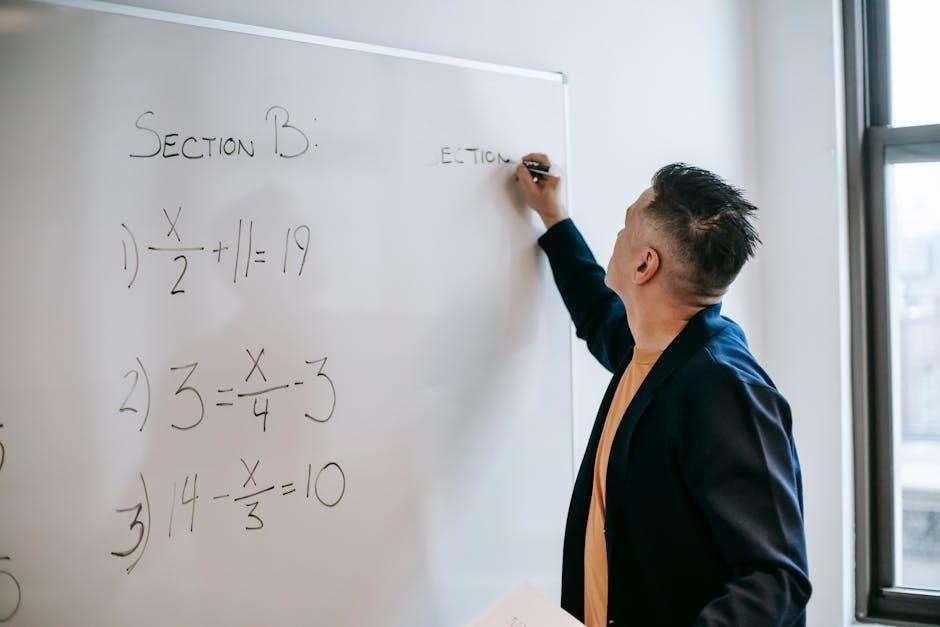
Solving linear equations is a cornerstone of Algebra 1. This unit builds from one-step equations to more complex multi-step equations‚ including those with variables on both sides. Remember to utilize inverse operations – addition/subtraction and multiplication/division – to isolate the variable.
Inequalities share similarities with equations‚ but instead of seeking a single solution‚ you’ll find a range of values. A crucial difference is flipping the inequality sign when multiplying or dividing by a negative number. Understanding this rule is vital for accurate solutions.
Practice is key! Expect your final exam to include a variety of equation and inequality problems. Focus on showing your work clearly and checking your answers. Review the concepts of combining like terms and applying the distributive property‚ as these skills are frequently used in solving these types of problems.
2.1 Solving One-Step Equations
One-step equations are the foundation for mastering algebraic problem-solving. These equations require only a single operation to isolate the variable. The core principle is maintaining balance – whatever operation you perform on one side of the equation‚ you must perform on the other.
Common one-step equations involve addition‚ subtraction‚ multiplication‚ or division. For example‚ to solve x + 5 = 12‚ you would subtract 5 from both sides. Similarly‚ for 3x = 15‚ you would divide both sides by 3. Always focus on undoing the operation applied to the variable.
Practice identifying the operation and its inverse. Ensure you understand the concept of inverse operations – addition and subtraction are inverses‚ as are multiplication and division. Mastering these basic equations will build confidence and prepare you for more complex problems later on. Remember to check your solution by substituting it back into the original equation!
2.2 Solving Two-Step Equations
Two-step equations build upon the foundation of one-step equations‚ requiring two operations to isolate the variable. The key is to follow the order of operations in reverse. Begin by addressing any addition or subtraction‚ and then tackle multiplication or division.
For instance‚ consider the equation 2x + 3 = 9. First‚ subtract 3 from both sides‚ resulting in 2x = 6. Then‚ divide both sides by 2 to find x = 3. Remember to consistently apply the same operation to both sides to maintain equation balance.
Carefully identify the operations being performed on the variable and their correct order for undoing them. Practice is crucial for developing fluency. Always double-check your answer by substituting it back into the original equation to verify its correctness. This ensures a solid understanding and minimizes errors during the final exam.
2.3 Solving Multi-Step Equations
Multi-step equations present a greater challenge‚ demanding a strategic application of multiple operations to isolate the variable. These equations often involve combining like terms‚ distributing‚ and then utilizing inverse operations – addition/subtraction and multiplication/division – in a logical sequence.
Begin by simplifying each side of the equation independently. This includes combining like terms and applying the distributive property to remove parentheses. Once simplified‚ proceed to isolate the variable using inverse operations‚ maintaining balance by performing the same operation on both sides.

Pay close attention to the order of operations and meticulously track each step. Errors can easily occur with increased complexity. Always verify your solution by substituting it back into the original equation. Mastering multi-step equations is vital for success on the Algebra 1 final exam‚ building a strong foundation for more advanced concepts.
2.4 Solving Equations with Variables on Both Sides
Equations featuring variables on both sides require a slightly different approach. The primary goal remains isolating the variable‚ but now you must strategically manipulate the equation to gather all variable terms on one side and constant terms on the other.

Typically‚ you’ll achieve this by applying inverse operations – adding or subtracting the same variable expression – to both sides of the equation. This eliminates the variable from one side‚ simplifying the equation. Then‚ proceed as with multi-step equations‚ using inverse operations to isolate the remaining variable.
Remember to maintain balance throughout the process. Careful attention to signs (positive and negative) is crucial to avoid errors. Always double-check your solution by substituting it back into the original equation to ensure accuracy. Proficiency in solving these equations is essential for the Algebra 1 final exam.
2.5 Solving Inequalities
Solving inequalities shares many similarities with solving equations‚ but a critical difference exists: the solution represents a range of values rather than a single value. Utilize inverse operations to isolate the variable‚ just as you would with equations.
However‚ a crucial rule applies when multiplying or dividing both sides of an inequality by a negative number. You must reverse the inequality sign to maintain the mathematical relationship. For example‚ if you divide by -2‚ a greater than (>) sign becomes a less than (<) sign.
Representing solutions often involves graphing on a number line‚ using open or closed circles to indicate whether the endpoint is included or excluded. Understanding symbols like ≤ (less than or equal to) and ≥ (greater than or equal to) is vital for success on the final exam.
Unit 3: Graphing Linear Equations and Functions
Mastering the visual representation of linear equations is crucial. This unit focuses on plotting equations onto the coordinate plane‚ building a strong foundation for understanding functions. Begin by familiarizing yourself with the coordinate plane – the x and y axes‚ and how ordered pairs (x‚ y) locate points.
A key skill is graphing equations in slope-intercept form (y = mx + b)‚ where ‘m’ represents the slope and ‘b’ is the y-intercept. The slope defines the steepness and direction of the line‚ while the y-intercept is where the line crosses the y-axis.
Practice identifying slope and y-intercept from given equations‚ and conversely‚ constructing equations from graphs. This unit prepares you to analyze and interpret linear relationships visually‚ a core concept for the final exam.

3.1 The Coordinate Plane
Understanding the coordinate plane is fundamental to graphing linear equations and functions. This two-dimensional system utilizes two perpendicular number lines: the horizontal x-axis and the vertical y-axis. Their intersection point is called the origin‚ represented by the coordinates (0‚ 0).
Every point on the coordinate plane is identified by an ordered pair (x‚ y)‚ where ‘x’ represents the horizontal distance from the origin and ‘y’ represents the vertical distance. Positive values move to the right and up‚ respectively‚ while negative values move to the left and down.
Practice plotting points accurately and identifying the coordinates of given points. Familiarize yourself with the quadrants formed by the axes – I‚ II‚ III‚ and IV – and how the signs of x and y change in each quadrant. A solid grasp of the coordinate plane is essential for visualizing and solving algebraic problems.
3.2 Graphing Linear Equations (Slope-Intercept Form)
Mastering the slope-intercept form‚ y = mx + b‚ is crucial for graphing linear equations. Here‚ ‘m’ represents the slope of the line – its steepness and direction – and ‘b’ represents the y-intercept‚ the point where the line crosses the y-axis.
To graph using this form‚ begin by plotting the y-intercept (0‚ b) on the coordinate plane. Then‚ use the slope ‘m’ (expressed as rise over run) to find additional points. For example‚ a slope of 2/3 means moving 2 units up and 3 units to the right from the y-intercept.
Connect these points with a straight line to represent the equation. Remember that any two points uniquely define a line. Practice converting equations into slope-intercept form when necessary and accurately identifying the slope and y-intercept. This skill is foundational for understanding linear relationships.
3.3 Slope and y-intercept
Understanding slope and y-intercept is fundamental to working with linear equations. The slope‚ often denoted as ‘m’‚ describes the rate of change of a line – how much ‘y’ changes for every unit change in ‘x’. It’s calculated as rise over run (Δy/Δx) between any two points on the line.
A positive slope indicates an increasing line‚ a negative slope a decreasing line‚ a zero slope a horizontal line‚ and an undefined slope a vertical line. The y-intercept‚ denoted as ‘b’‚ is the point where the line crosses the y-axis; at this point‚ x = 0.
Identifying these key features allows you to quickly sketch a graph and interpret the relationship between variables. Recognizing slope as a rate of change has real-world applications in various fields. Mastering these concepts is essential for success on your final exam!
3.4 Writing Linear Equations in Slope-Intercept Form
Slope-intercept form is a powerful way to represent linear equations: y = mx + b‚ where ‘m’ is the slope and ‘b’ is the y-intercept. Being able to convert between different forms is crucial for solving problems efficiently.
To write an equation in slope-intercept form‚ you often need to rearrange an equation given in standard form (Ax + By = C) or use information about the line’s slope and a point it passes through. If given two points‚ first calculate the slope using the formula (y₂ — y₁) / (x₂ — x₁)‚ then substitute the slope and one of the points into y = mx + b to solve for ‘b’.
Practice converting equations and finding equations from given information. This skill is frequently tested on the final exam‚ so ensure you’re comfortable with the process!
Unit 4: Systems of Equations and Inequalities
Systems of equations involve finding the point(s) where two or more lines intersect. You’ll need to master three primary methods: graphing‚ substitution‚ and elimination. Graphing allows for a visual representation‚ but can be less precise. Substitution is effective when one equation is easily solved for a variable. Elimination (or addition) works by adding or subtracting equations to eliminate one variable.
Systems of inequalities involve finding the region where the solutions to multiple inequalities overlap. Graph each inequality‚ remembering to use a dashed line for ‘greater than’ or ‘less than’ and shade the appropriate region. The solution is the area where all shaded regions intersect.
Understanding when to apply each method and interpreting the solutions (one solution‚ no solution‚ or infinite solutions) is vital for success on the final exam. Practice identifying and solving various system problems!
4.1 Solving Systems of Equations by Graphing
Solving systems of equations by graphing involves plotting each equation on the coordinate plane and identifying the point of intersection. This point represents the solution to the system‚ satisfying both equations simultaneously. First‚ rewrite each equation in slope-intercept form (y = mx + b) to easily identify the slope and y-intercept.
Graph each line carefully‚ ensuring accuracy. The point where the lines cross is the solution – express it as an ordered pair (x‚ y). If the lines are parallel‚ there is no solution‚ as they never intersect. If the lines coincide (are the same line)‚ there are infinite solutions‚ as every point on the line satisfies both equations.
Remember to check your solution by substituting the x and y values back into the original equations to verify its correctness. Graphing provides a visual understanding of the system’s behavior and solution.
4.2 Solving Systems of Equations by Substitution
Solving systems of equations by substitution is a powerful algebraic technique. Begin by solving one of the equations for one variable in terms of the other. For example‚ solve for ‘y’ in terms of ‘x’. Then‚ substitute this expression into the other equation‚ eliminating one variable and creating a single equation with only one variable.
Solve this new equation for the remaining variable. Once you’ve found the value of one variable‚ substitute it back into either of the original equations (or the expression you created earlier) to find the value of the other variable. Express your solution as an ordered pair (x‚ y).
Always check your solution by substituting both x and y values into both original equations to ensure they hold true. Substitution is particularly useful when one equation is already solved for one variable‚ or easily rearranged to do so.
4.3 Solving Systems of Equations by Elimination
Solving systems of equations by elimination‚ also known as the addition method‚ involves manipulating the equations to eliminate one of the variables when they are added together. This is achieved by multiplying one or both equations by a constant so that the coefficients of either x or y are opposites.
Once the coefficients are opposites‚ add the two equations together. This will eliminate one variable‚ leaving you with a single equation containing only one variable. Solve this equation for the remaining variable. Then‚ substitute the value you found back into either of the original equations to solve for the other variable.
Remember to check your solution by substituting both values into both original equations. Elimination is particularly effective when the coefficients of one variable are already opposites or can easily be made so.
Unit 5: Exponents and Polynomials
Mastering exponents and polynomials is crucial for success in Algebra 1. This unit focuses on understanding and applying the rules of exponents‚ including product‚ quotient‚ power‚ and zero exponent rules. You’ll learn how to simplify expressions involving exponents and utilize them effectively.
Polynomials are then introduced‚ covering operations like addition and subtraction. You’ll practice combining like terms and simplifying polynomial expressions. A key skill is multiplying polynomials‚ which includes distributing and applying the FOIL method (First‚ Outer‚ Inner‚ Last) for binomials.
Be prepared to simplify expressions‚ perform operations‚ and apply these concepts to solve various algebraic problems. A solid grasp of these fundamentals will build a strong foundation for future mathematical studies. Practice is key to confidently navigating exponent rules and polynomial manipulations!
5.1 Exponent Rules
Understanding exponent rules is foundational to simplifying algebraic expressions. This section dives deep into the core principles governing exponents. You’ll learn the product of powers rule (xm * xn = xm+n)‚ the quotient of powers rule (xm / xn = xm-n)‚ and the power of a power rule ((xm)n = xm*n).
Crucially‚ you’ll need to grasp the concept of a zero exponent (x0 = 1) and negative exponents (x-n = 1/xn). These rules are essential for manipulating expressions and solving equations efficiently. Remember to apply these rules correctly‚ paying close attention to the base and exponent.
Practice applying these rules in various combinations to build fluency. Expect problems requiring you to simplify expressions with multiple exponents and different bases. Mastery of these rules will significantly improve your ability to work with polynomials and other algebraic concepts.
5.2 Operations with Polynomials (Addition‚ Subtraction)
Polynomials are algebraic expressions consisting of variables and coefficients. This section focuses on performing addition and subtraction operations with these expressions. The key principle is to combine like terms – terms that have the same variable raised to the same power.

When adding polynomials‚ simply add the coefficients of like terms. For example‚ (3x2 + 2x ⸺ 1) + (x2 ⸺ 5x + 4) becomes 4x2 ⸺ 3x + 3. Subtracting polynomials involves distributing the negative sign to each term in the second polynomial before combining like terms.
Pay close attention to signs! A common mistake is incorrectly distributing the negative sign during subtraction. Remember to maintain the correct order of operations and simplify the resulting expression. Practice with various polynomial combinations to solidify your understanding and avoid errors on the final exam.
5.3 Multiplying Polynomials
Multiplying polynomials requires applying the distributive property. When multiplying a monomial by a polynomial‚ distribute the monomial to each term within the polynomial. For example‚ 2x(x2 + 3x, 1) equals 2x3 + 6x2 ⸺ 2x.
When multiplying two binomials‚ you can use the FOIL method (First‚ Outer‚ Inner‚ Last) to ensure all terms are multiplied. For instance‚ (x + 2)(x — 3) expands to x2 ⸺ 3x + 2x — 6‚ which simplifies to x2, x — 6.
Remember to combine like terms after applying the distributive property or FOIL method. Be meticulous with signs‚ as incorrect sign placement is a frequent error. Practice multiplying various polynomial combinations‚ including binomials‚ trinomials‚ and larger expressions‚ to master this skill for the final exam. Careful organization will prevent mistakes!
Leave a Reply
You must be logged in to post a comment.